



In the last two videos, I returned to current affairs because, once again, the news brought me back to the Bible. Not in a general way, but in a specific way: through the names of military operations, prophetic references, categories of ‘necessary’ war, and symbolic images that serve to make violence acceptable, more natural, inevitable, even obligatory because it is willed by God when it is aimed at the conquest and defense of the so-called promised land. This is the point that interests me: not the devotional use of the text, but its use as a tool for legitimizing power.
Biblical language as a tool for legitimizing power
When I talk about “caste,” I am not engaging in conspiracy theory. I am pointing to an ancient and at the same time very current structure: a power that represents itself as necessary, that feels itself above common judgment and, above all, that builds its own consensus using sacred language. In this mechanism, the Bible is not simply a religious book: it is an archive of formulas of command.

The “roar of the lion”: Amos and biblical symbolism in contemporary warfare
The most obvious example these days is the name given to the Israeli operation against Iran: sha’agat ha’arieh, “The roar of the lion.” Many have referred to Amos 3:8:
“אַרְיֵה שָׁאַג מִי לֹא יִירָא / Adonai YHWH dibber, mi lo yinnave?”,
meaning: “The lion has roared, who will not fear? The Lord YHWH has spoken, who will not prophesy?”
But here there is a decisive fact that I wanted to emphasize: Amos does not speak against external enemies; he speaks against Israel, against its sins, which are nothing more than disobedience to Yahweh’s commands, and he announces the punishment that will befall it.
The same chapter also contains Amos 3:4:
“Does a lion roar in the forest when it has no prey?”
So the reference to the lion is not innocent: in the biblical text, the roar signals prey, a threat, an action already oriented toward capture. The figure of the lion recurs frequently in the Bible—from Genesis to the Book of Proverbs, from the Second Book of Samuel to the prophets Isaiah and Hosea—and represents strength, dominion, and the inevitability of action.
When that symbol is transferred to contemporary warfare, the effect is clear: violence ceases to appear as a political decision and presents itself as an almost natural, almost prophetic gesture.
Dalia Gavriely-Nuri’s study on the language of military operations
Here, the work of scholar Dalia Gavriely-Nuri, a professor at Tel Aviv University, is illuminating. In her research on Israeli military language, she has shown that the names of operations are by no means neutral. Giving military operations names taken from nature or the Bible has three fundamental effects: naturalization, euphemization, and legitimization of war.
In other words, war becomes more speakable and more acceptable, integrated into the collective mental landscape. It is no longer just war: it becomes destiny, historical continuity, identity.
The relationship between Israel and Persia in the Bible
There is another observation that I consider decisive. If one really wanted to find a historical justification in the Bible for the conflict with Persia, it would be difficult to do so. In fact, the biblical picture points in the opposite direction.
In Isaiah 45:1, Cyrus is even called “anointed,” that is, mashiach:
“Thus says YHWH to his anointed, to Cyrus…”
This is because he freed the people from Babylonian rule.
In Ezra, Nehemiah, and Daniel, other Persian rulers—Darius I, Xerxes I, Artaxerxes—perform acts favorable to the Israelites, even allowing the reconstruction of the temple and the walls of Jerusalem.
And in the narrative tradition of the Book of Esther, the Persian kingdom even becomes the context in which the Jews are saved from the threat of extermination.
This means one very simple thing: the current conflict has no linear basis in biblical memory. If anything, the Bible is selectively reused to provide a symbolic coating for contemporary interests.
contemporanei.
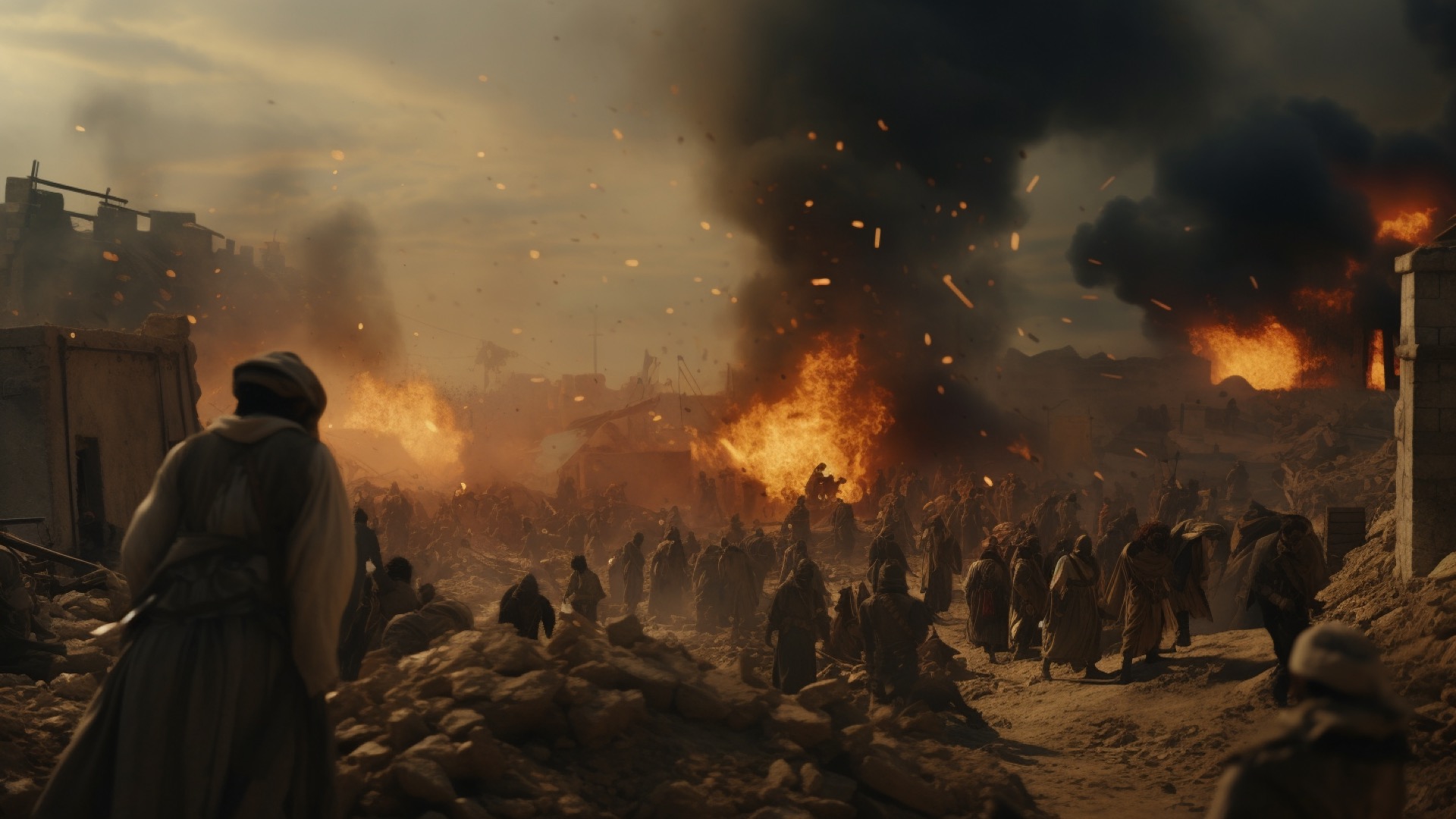
The dual power in the Bible: political authority and religious authority
And this is where the “caste” returns. In the texts of the Old Testament, I often see a dual power: on the one hand, political power, on the other, priestly power; on the one hand, operational command, on the other, its religious cover.
Moses and Aaron—the civil leader and the religious leader—are a very clear example of this alliance.
It is a structure that does not obey common rules: it imposes them. When it judges, it always judges from above. Civil laws and religious laws constitute a whole, as is still the case today in theocratic systems.
This is why I continue to say that the Bible should be read without theological anesthesia: not because it should be demonized, but because only in this way does it reveal its real content, which is not spiritual but deeply political.

The mechanism of power: problem, reaction, solution
The point, therefore, is not to ask whether or not a new elite exists. The point is to understand how it authorizes itself.
And I see that it continues to authorize itself with the same tools as always: promise, election, necessary war, absolute enemy, sacralization of conquest.
The news passes, but the mechanism remains. It often applies a tried and tested technique: creation of a problematic situation, reaction of the people demanding a solution, intervention of the power that has planned the sequence of events to present the final conclusion—actually decided from the outset—as a necessary act and even one demanded by the people themselves.

