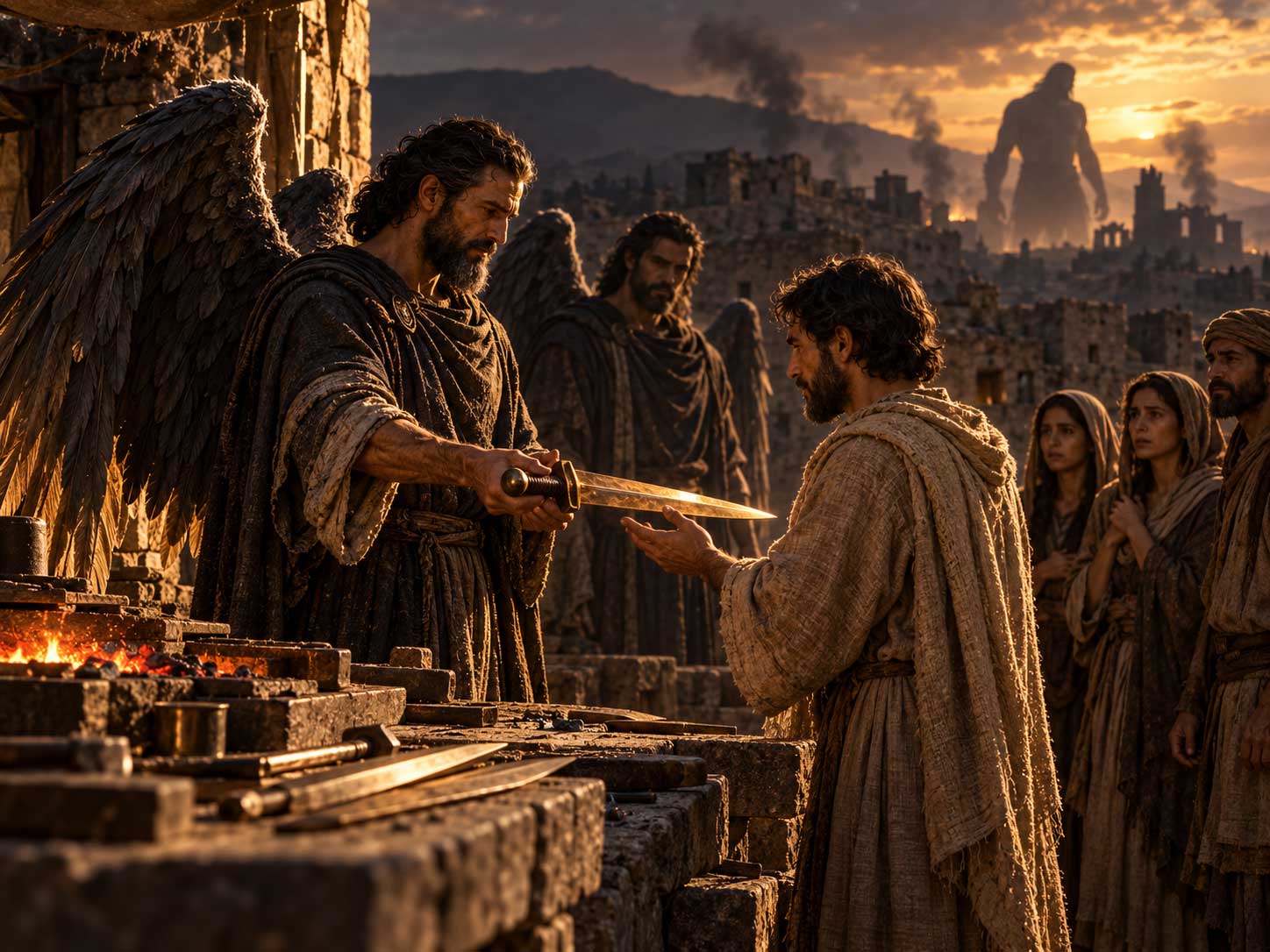
When we return to the Book of Enoch, we are often drawn to the patriarch’s journeys, the descriptions of the heavens, and his relationship with the Elohim. This time, however, I want to focus on another aspect: a difference that emerges when we compare the Book of Parables with the New Testament accounts. In the Enochic text, we encounter an Elect One, also called the Son of Man, who is entrusted with tasks that will determine the fate of the righteous and the powerful. Yet his story is not that of the Jesus we know through the Gospels. How should we understand this difference, especially given the similarities between the language of the Parables and that of the Christian writings? This is the question I began with in my third video on Enoch, and which I want to explore further here. First, let me remind you that the so-called Book of Enoch is not a unified work. The corpus we call 1 Enoch comprises five main sections: the Book of the Watchers, the Book of Parables, the Astronomical Book, the Book of Dreams, and the Epistle of Enoch. These texts were composed and transmitted at different times, and we cannot simply attribute them all to a single author or period. When we speak of Enoch, then, we must always ask which part of the collection we are reading. The corpus has survived in its entirety in Geʽez, the ancient Ethiopic language still used in the liturgy of the Ethiopian and Eritrean Orthodox Churches. Its history, however, also includes textual witnesses in other languages and a long process of manuscript transmission. This means dealing with variants, translation difficulties, and passages in which it is not always easy to distinguish the narrator’s voice from those of the characters. Before putting forward confident interpretations, we must remember just how complex the document before us is. The section I want to focus on is the Book of Parables, which occupies chapters 37–71 of 1 Enoch. Here we encounter a figure designated as the Elect One and the Son of Man, associated with judgment and justice. Before him, the powerful must answer for their actions. The righteous await recognition of their plight, while an order dominated by violence is destined to be overthrown. These images may sound familiar to readers of the New Testament. Yet that very familiarity calls for care: we cannot automatically identify the central figure of the Parables with Jesus simply because certain titles or functions appear to coincide. The question I ask myself is simple: are we reading what the text tells us, or are we already introducing what we know through Christian tradition? In the video, I highlighted several parallels. In both the Book of Parables and the Book of Revelation, we find judgment, the terror of kings and the powerful, the presence of the throne, and the expectation of justice. The overthrow of the powerful from their thrones, which we read about in the Magnificat spoken by Mary in Luke’s Gospel, also recalls an image found in the Parables. Other parallels concern affliction likened to the pains of childbirth and language relating to spirits. These similarities deserve to be studied. They invite us to ask what relationships exist between the works and what shared stock of imagery was available to their authors. However, a parallel does not automatically prove that one text depends on the other. We must also consider the possibility that different authors drew on shared traditions. Assessing any possible relationship of dependence requires detailed comparisons, a reconstruction of the context, and, above all, a reliable chronology. This brings us to the difference I want to draw attention to. The Elect One of the Parables passes judgment, acts against injustice, and offers hope to the righteous. He does not, however, undergo a redemptive passion and crucifixion of the kind described in the Gospels. The Enochic text does not present the same sequence of suffering, death, and resurrection on which the Christian proclamation is founded. Its central figure is not described as someone who redeems humanity through the sacrifice of his own life. This difference interests me because it prevents us from treating every messianic figure as an already fully formed anticipation of Jesus. We can recognise common elements without erasing what distinguishes the accounts. Enoch’s Son of Man must first be read within the work to which he belongs, with his own functions and characteristics. At this point, dating becomes crucial. When were the Parables composed? The question remains debated. A substantial body of scholarship places them between the late first century BCE and the early first century CE; later dates have also been proposed in the history of research. We therefore cannot take it for granted that the author was writing after the crucifixion and was already familiar with Christian preaching. If the text predates those events, its silence about Jesus does not pose the problem that a later work might. Even if we assume a later composition, however, the absence of an explicit reference would not automatically prove that the author knew nothing of Jesus or wished to erase his memory. A text can develop the expectations of its own community without discussing other religious movements. The question remains legitimate, but we must distinguish what we observe from the explanations we propose: the text does not recount the Gospel story of Jesus; establishing why it does not is a further question. n the video, I also connected this question with the Book of Wisdom. Here we must bear in mind that its dating is not unanimously agreed upon, and that a widely accepted proposal places it in the first century BCE. We therefore cannot use it as evidence of a work written after Jesus whose author supposedly knew nothing of his existence. Moreover, the order of the books in Bibles does not necessarily reflect their chronological sequence. There is, however, a question I want to reflect on: we are accustomed to reading the entire Old Testament as a path leading progressively towards Jesus. This is the Christian reading of Scripture as a whole, but it does not automatically coincide with the perspective of each individual author. To understand these texts, we must try to place them back within their own questions, communities, and expectations, without attributing to them advance knowledge of later developments. Another important difference concerns the origin of evil. In the Enochic tradition, the transgression of the Watchers and the destructive knowledge transmitted to human beings play a central role. Violence and corruption are explained through a story involving heavenly beings, women, men, and giants. This framework must be distinguished from the later Christian development of the doctrine of original sin. The account of Adam and Eve’s transgression and the doctrine of guilt inherited by all humanity are not simply the same thing. Here too, however, this difference alone is not enough to explain the history of the canon. The fact that Enoch has remained canonical in the Ethiopic tradition, while belonging neither to the Jewish canon nor to that of most Christian Churches, requires a historical reconstruction that cannot be reduced to a single cause. We must not give up asking questions. We must formulate them precisely, distinguishing what the texts tell us from what we can hypothesise and from what, for now, we do not know. This is also the purpose of the work I continue to share: to return to the documents, compare them, and leave open the questions we cannot yet resolveThe Book of Enoch: Five Books, Many Questions
The Elect One in the Book of Parables
Similarities with the New Testament
A Son of Man Who Is Not Crucified
When Were the Parables of Enoch Written?
The Book of Wisdom and the Idea of a Single Path
The Watchers and a Different Explanation of Evil
Conclusion: Reading Without Assuming the Answers