



When a story about Peter is told in the Vatican Gardens, broadcast in prime time on Rai 1 and welcomed by the church hierarchy, we are no longer dealing with a simple artistic performance. In that setting, theater inevitably takes on the weight of an endorsed narrative, and for this very reason it becomes legitimate to ask what, of what is told, really stands up to the scrutiny of the sources.
In this article, I retrace the central points of the monologue “Pietro, un uomo nel vento” (Peter, a man in the wind) and compare them with the texts: the Gospels, the Acts of the Apostles, manuscript variants, Greek lexicon, tradition, and theological stratifications. Not to replace one dogma with another, but to restore the reader’s right to critical reading.
The context: when theater becomes endorsed narration
There is a preliminary point that is often overlooked in the debate following the prime-time broadcast of “Pietro, un uomo nel vento” on Rai 1. The issue is not so much Roberto Benigni‘s performance as an actor, nor the artistic legitimacy of a theatrical monologue. The issue is the context. A story told inside the Vatican, in its most inner and symbolically significant part—the Secret Gardens—broadcast in prime time on the flagship channel of public television, and moreover previewed and welcomed by the highest echelons of the Church. In this shift of setting, theater ceases to be just theater. The performance, due to the power of the device that supports it, inevitably takes on the weight of an official narrative, or at least an endorsed narrative, not because it is explicitly stated, but because the scene itself suggests it.

Method of analysis: text, tradition, superstructure
My analysis stems from this premise. It is not a judgement on the artist’s intention, nor a criticism of his communicative ability. It is a check of consistency between what is told with such strong institutional authority and what the texts convey. The method is one that I have been following for years in the study of biblical sources: to distinguish, as far as possible, between what is written and what has been superimposed over time, between textual data and theological elaboration, between tradition and subsequent reading. Not to replace one truth with another, but to give the reader the opportunity to verify.

Faith, history, and sources: where the story ends and the texts begin
The first issue concerns the word that runs through the entire monologue: faith. It is taken as the narrative axis and as the key to the identity of the figure of Peter, to the point of arriving at the assertion that being faithful also means doubting. Here, however, I believe a clear distinction is necessary. Faith, by definition, is adherence to what cannot be seen, to what cannot be proven. Doubt is already a question. And a question is already a step towards reasoning, that is, towards a realm different from the act of faith. I am not expressing a value judgment: I am drawing a logical distinction. If one accepts that faith and doubt coincide, one ends up confusing different planes: believing and analyzing, the act of trust and verification.
This distinction becomes even clearer if we look at the history of the Church itself. Texts proclaimed as “inspired” have been continuously discussed, interpreted, and reworked, even by ecclesiastical scholars. There is therefore a structural tension: on the one hand, the faithful are asked to adhere, while on the other, an enormous amount of analysis and doctrinal debate takes place. Popular accounts tend to simplify this complexity; I felt it necessary to bring it back to the forefront, because it is precisely there, in my opinion, that the distance between narrative and document comes into play.
Archeology, devotion, and the status of certainty
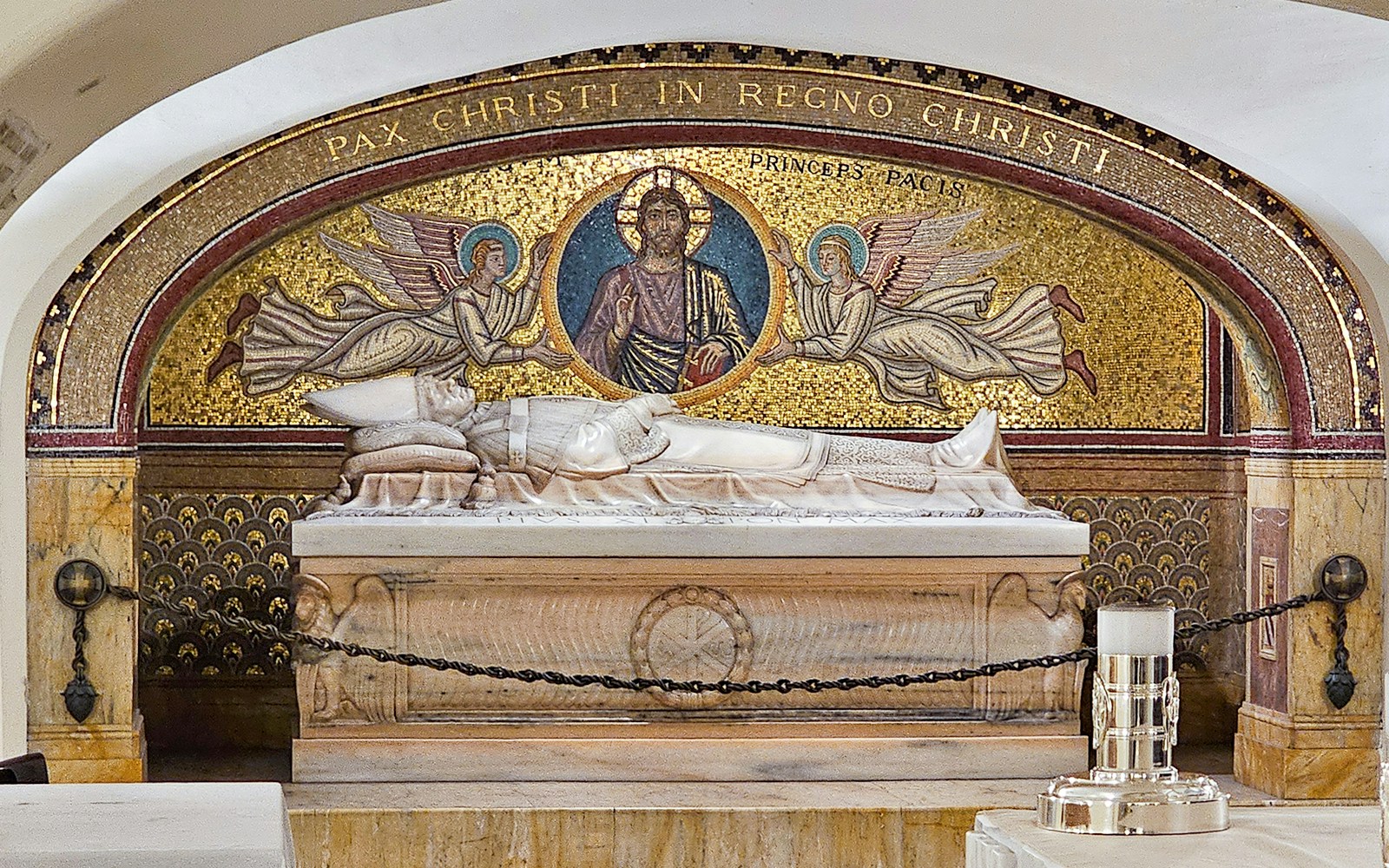
Another extremely delicate point is that of Peter’s bones and his tomb. In the monologue, peremptory statements are made and presented as certainties. I do not question the archaeological work, which will certainly have been carefully and thoroughly carried out, but I define its status: an archaeological investigation, even an excellent one, is not equivalent to absolute certainty. Prudence is not gratuitous skepticism: it is already present in the language with which the ecclesiastical hierarchies themselves modulate these statements when they speak among themselves.
The fact that the Latin term “putantur,” “it is believed that they are,” is used clearly indicates that there is no total certainty. It is interesting to note how this caution emerges in internal language, while in public discourse it is often replaced by categorical statements. Faith intervenes in that space, filling in what history cannot prove.

Peter and the origins of Christianity: identity, conflicts, power
Moving on to the figure of Peter, the proposed account presents him as a simple fisherman, at times naive, almost clumsy. Without denying the Gospel data on his profession, I find this representation reductive. The Galilean context of the first century was marked by very strong political and messianic tensions. The epithet “bar yonah,” read in the light of that context, may indicate membership in anti-Roman rebel groups. From this perspective, “fisherman” does not exhaust Peter’s identity, but represents only a part of it. What emerges is a more conscious, adult figure, involved in a project that entailed real risks. Not a good-natured character who makes mistakes out of naivety, but a man involved in a revolutionary dynamic of power and messianic expectation.

Rome, Paul, and persecution: Christianity as a field of tension
This picture becomes even clearer when we talk about the “conquest of Rome through faith.” Here we tend to forget the decisive role of Paul. Historical Christianity, as we know it, is largely the result of his theological elaboration. The Pauline letters, which predate the Gospels, bear witness to very strong contrasts within the movement, such as the so-called “Antioch incident.” There is no such thing as a compact and harmonious original Christianity: there is a field crossed by conflicts on fundamental issues, such as the relationship with pagans, Mosaic law, circumcision, and the common table. In this context, Peter is not the pacified pivot of an already defined Church, but a controversial figure.
The issue of persecution must also be studied carefully from a historical perspective. Preaching a new god in Rome was not in itself a problem. Rome was open to a plurality of cults. The real issue was political: the refusal to worship the emperor. This is what made Christians dangerous, not their faith as such. Separating the religious from the political is essential to understanding the dynamics of persecution.
Another narrative element that I wanted to reevaluate is the age of the protagonists. Talking about “boys” is misleading. At thirty, in the ancient world, men were fully grown. And if we take historical chronology seriously, as I have done in my studies, a possible lifespan for Jesus emerges that is very different from the traditional one. This is not to create new certainties, but to show how the use of youth often has an emotional, not a historical, function.
Philological issues and alternative traditions: variants, lexicon, memory
The same criterion applies to the relationship between Jesus and the Pharisees. The clear contrast that is often presented to us is a later construction. The texts show a dialectical relationship, typical of the rabbinical world, made up of discussion and confrontation. Jesus was no stranger to that world; he was part of it. In the Gospel of Luke, for example, there are episodes in which some Pharisees warn Jesus of danger and others in which Jesus enters the house of a Pharisee leader to eat. These details do not negate the conflicts narrated, but they prevent the scene from being transformed into a simplified ideological duel, constructed to achieve a linear catechetical effect and, historically, often a harbinger of hostility towards Judaism.
A particularly revealing passage, and one that is decisive in understanding how translation can become ideology, concerns the Greek verbs “agapáō” and “philéō” in the Gospel of John. In Benigni’s account, an emotional crescendo is built up around the supposed difference between ‘love’ and “good,” between an absolute question and an almost fearful answer from the “fisherman.” However, if we proceed with a philological approach, relying on dictionaries and occurrences, comparing general, etymological, and specific lexicons of New Testament Greek, we see that the two verbs are largely overlapping and even interchangeable. Furthermore, in the text itself, in the third question, Jesus uses the same verb as Peter: the dialogue ends with the same word used by both interlocutors. The conclusion is not that the dialogue is not intense; the conclusion is that this intensity cannot be demonstrated on the basis of a theatrical micro-difference in language, when Greek does not support it so clearly. Emotion is legitimate, but it cannot be disguised as philology.
Grey areas, apocrypha, and iconographic traces
Apocrypha and Mary Magdalene: plurality of traditions and selected memory

Finally, I would like to make a brief reference to Renaissance art, with particular attention to some details of Leonardo’s Last Supper and Michelangelo’s Pietà, which, in my opinion, reveal a precise cultural signal: unofficial ideas can survive doctrines and be communicated iconographically, especially in cultured, hermetic, academic circles frequented by artists such as Leonardo and Michelangelo. I cite these two works as evidence, not as philological ‘proof’, to show that certain lateral traditions – especially those related to the role of Mary Magdalene – can also emerge outside canonical texts, in iconographic forms intended for a cultured audience. The two works, created in the same years (1495–1499), seem to belong to the same intellectual climate: in The Last Supper, a female figure appears next to Jesus, whom many interpret as Mary Magdalene; in The Pietà, on the other hand, the woman holding Jesus’ body has a surprisingly young face compared to the plausible age of Mary, mother of Jesus, if we consider a chronology of Jesus’ life different from the traditional one. We can imagine that, in the academic and hermetic circles frequented by artists and also in contact with high ecclesiastical circles, ‘confidential’ readings and memoirs could circulate, capable of crossing official doctrine without exposing themselves openly, leaving traces in the form of images. Here I will take a more daring interpretative step, and I say this clearly: this is not a philological demonstration in the same sense as analyses of Greek or textual variants; it is a cultural hypothesis, plausible in context but not verifiable with the same degree of certainty. Its function, however, remains consistent with the overall picture: even in high circles, knowledge or traditions not intended for the people can circulate, and the boundary between public doctrine and confidential knowledge is part of the history of the Church itself.


