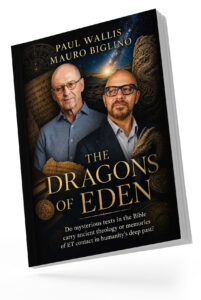


This book stems from the intersection of biblical scholarship and the mythological and religious traditions of distant cultures, with the aim of exploring the surprising parallels between figures such as Yahweh, the Elohim, the dragons of ancient China, and the feathered serpents of the Americas. By comparing texts and tales from different eras and continents, new questions arise about the origins of sacred narratives and the possibility that they preserve traces of shared memories or interpretations yet to be deciphered. What do Yahweh, the Elohim, the dragons of ancient China, the feathered serpents of the Americas, and the civilizing beings remembered in the traditions of peoples separated by vast distances have in common? This is the question that gave rise to The Dragons of Eden, the new book I co-authored with Paul Wallis, which we have published in both Italian and English. At first glance, these figures seem to belong to irreconcilable worlds. They come from cultures separated by oceans, continents, and millennia of history. However, when we set aside conventional religious interpretations for a moment and compare the stories, similarities emerge that are at least worth noting. In many ancient traditions, we encounter beings associated with the sky and flight, capable of imparting knowledge, establishing laws, exercising power, controlling the waters, and intervening directly in human lives. In some cases, they are remembered as rulers and benefactors; in others, they become adversaries, monsters, or deities to be fought. Are these merely universal symbolic images, or do these stories preserve—in different and inevitably transformed forms—the memory of concrete experiences? This book stems from the convergence of two very different paths. I have been working for decades on the Hebrew text of the Bible, using a method my readers are familiar with: reading what is written, distinguishing it as much as possible from the theological interpretations developed in subsequent centuries. I do not claim to possess definitive truths, nor do I presume to explain every biblical passage. Rather, I seek to restore the text’s concreteness, leaving open the questions to which we cannot yet answer. Paul Wallis, on the other hand, comes from over thirty years of ministry in the Anglican Church. He served as an archdeacon and taught theology, hermeneutics, and the history of Christian thought, training pastors and ministers. He therefore has an insider’s understanding of traditional religious interpretation, having studied, taught, and preached it for many years. It is precisely this experience that led him to pose a question as simple as it is unsettling: if we had not been taught in advance that Yahweh is the one, transcendent, and universal God, what kind of figure would we reconstruct based exclusively on the actions, words, and characteristics attributed to him in the biblical narratives? It is around this question that our paths converge. Suspending the automatic identification of Yahweh with the God of theology means returning to the words and contexts of the Hebrew Bible. A key example is the term Elohim. In translations, it is frequently rendered as the singular “God,” but in the biblical text it can refer to Yahweh, other individuals, groups of beings, and various realities. It is therefore not possible to always attribute the same meaning to it without examining each individual context. In biblical narratives, we encounter assemblies, hierarchies, territorial divisions, covenants, rivalries, and conflicts. Yahweh dialogues with other entities, confronts them, and commands the Israelites not to follow or serve the Elohim of other peoples. If these others did not exist, why forbid their worship? And if the term Elohim always and only referred to the one God of theology, how would one explain the numerous scenes in which a plurality of protagonists appear? Our book does not sidestep these difficulties. Instead, it places them at the center of our inquiry. In the Western imagination, the dragon has become above all an evil monster: a chaotic creature to be vanquished, as in the stories of Saint George or in medieval narratives. This interpretation, however, is not universal. In China and other Asian cultures, the dragon is often associated with sovereignty, wisdom, prosperity, water, and cosmic order. In numerous traditions across Asia, Africa, Oceania, and the Americas, serpentine, feathered, winged, or dragon-like beings are associated with the transmission of knowledge, the founding of civilizations, agriculture, astronomy, and the rules of human coexistence. Paul Wallis follows these trails across vastly distant continents and traditions: from China to Japan, from India to Benin and Cameroon, from Turkey to Iran, all the way to Oceania, the Americas, and Europe. These parallels do not automatically prove a common origin. Superficial similarities can also arise independently and must be evaluated with caution. However, when certain elements recur persistently—the connection to the sky, flight, power, water, knowledge, and influence on human communities—dismissing it all as coincidence risks being too convenient an answer. One of the book’s most provocative themes concerns the story of the Garden of Eden. We have been accustomed to reading it as the story of humanity’s disobedience to God and the entry of sin into the world. But the Hebrew text of Genesis does not contain the doctrine of original sin as it would later be formulated. Nor is the serpent identified with Satan: this association belongs to a later theological interpretation. In the story, the serpent appears as an intelligent being who challenges a prohibition and reveals to human beings the possibility of accessing knowledge that had been denied to them. The focus of the story is not only transgression, but also the control of knowledge and human autonomy. Why is access to the tree of knowledge forbidden? Why, after man has eaten its fruit, do the divine protagonists express concern that he might also gain access to the tree of life? And why is the human being ultimately banished and kept under watch? Read outside the doctrinal framework, the story takes on the characteristics of a conflict between powers with different plans for humanity. The book also addresses another crucial question: Do ancient tales truly describe a creation ex nihilo, or do they speak of an intervention carried out on already existing human beings? In the Bible, as in other traditions of the ancient Near East, man is destined for work, service, and the stewardship of a territory. The protagonists involved in humanity’s origin do not appear to be detached from the material world: they make decisions, take action, issue orders, move about, gather together, and express very concrete needs. Paul relates these accounts to traditions from distant cultures, in which superior beings modify, instruct, or organize human populations. These analogies do not constitute scientific proof of genetic manipulation and do not justify arbitrary conclusions. They do, however, raise a legitimate question: were the ancients attempting to symbolically explain the origin of humanity, or were they preserving the memory of interventions for which they lacked the linguistic and technical tools to describe them otherwise? Another central theme concerns the emergence of monotheism. We are accustomed to projecting the idea of a single God onto every page of the Bible, even the oldest ones. But the texts preserve traces of a much more complex landscape, populated by various Elohim, territorial powers, and communities that recognized different deities. The transition to monotheism may therefore not represent the starting point of biblical history, but rather the outcome of a long political, cultural, and religious evolution. Texts originating in different eras would have been collected, transmitted, and interpreted within a later framework capable of transforming one of the protagonists into a universal and transcendent principle. Recognizing this stratification does not mean denying the faith of those who read the Bible as a sacred text. It means distinguishing textual analysis from religious adherence and remembering that the two perspectives do not necessarily answer the same questions. Paul and I do not always say the same things, nor do we necessarily reach the same conclusions. It is precisely this difference that makes our work stimulating. Paul broadens the inquiry by comparing the traditions of numerous peoples; I focus primarily on the Hebrew text, seeking to determine which claims have verifiable evidence and which must remain in the realm of hypothesis. We do not ask the reader to believe that every dragon was a vehicle, that every deity was an extraterrestrial, or that every myth constitutes a faithful account of a historical event. Such a conclusion would be just as simplistic as the opposite attitude, which reduces every ancient tale to fantasy, superstition, or religious allegory. Between uncritical acceptance and preemptive rejection lies the space for research. It is the space in which texts, images, traditions, and testimonies are compared, always distinguishing facts from interpretations and possibilities from certainties. With The Dragons of Eden, we aim to bring the Bible out of the theological bubble in which it has often been isolated and reintegrate it into humanity’s broader narrative heritage. When biblical stories are juxtaposed with the traditions of ancient China, India, Africa, the Americas, Oceania, and the Near East, questions multiply. Dragons and serpentine beings may simply be symbols born of human fears and aspirations. However, they may also preserve distant memories, altered by oral transmission, religion, politics, and the passage of millennia. We do not offer a new truth to be accepted, nor a doctrine to replace previous ones. We present accounts to be compared, words to be reexamined, and hypotheses to be judged by the reader. Perhaps what we have called “myth” preserves fragments of a history far more concrete, complex, and surprising than we have imagined. To discover this, we must observe the clues without fear, but also without forcing them. This is the invitation that Paul and I extend through The Dragons of Eden: to read, compare, doubt, and continue to ask questions. Enjoy the read.A Journey Beyond the Boundaries of the Bible

Two Different Paths, One Common Question

Yahweh and the Elohim: Returning to the Words of the Text

Dragons Are Not Just Monsters

The Serpent of Eden and Forbidden Knowledge

Creation of Man or Intervention in Man?

Monotheism as a Later Reinterpretation

An Open Dialogue, Not a New Doctrine
An invitation to re-read the history of humanity