



When we approach the Bible from a philological rather than a theological perspective, a surprisingly human picture emerges: the need to know the unknown, the desire for psychological security, and the ease with which one can fall victim to deception that exploits fears and expectations. The theme of forbidden magic fits perfectly here, between the pragmatic awareness of Yahweh, the prohibitions transmitted by the editors, and the people’s resistance to giving up practices that had been rooted for centuries.
In this respect, the Bible is an extraordinarily sincere document: it records prohibitions and also records transgressions, showing the normative intent and social reality, highlighting internal contradictions and even errors that the manuscript tradition has kept intact.
Yahweh’s prohibitions and the difficulty of defining biblical magic
One of the clearest texts on the subject is found in Deuteronomy 18, where it is explicitly stated that there shall be no one among the people who practices divination, sorcery, augury, magic, enchantments, who consults spirits, fortune tellers, or who questions the dead. This is a broad list, and it is by no means easy to establish philologically the precise meaning of the individual Hebrew terms, because modern categories—magic, witchcraft, spiritism, clairvoyance—do not necessarily coincide with ancient ones.
The biblical author seems to want to cover the entire spectrum of magical-divinatory practices known in the ancient Near East, prohibiting them en masse precisely because, from the point of view of the narrative, they represent a danger of deception. It is not surprising, therefore, that the prohibitions are repeated with great insistence.
In Leviticus 20, the punishment becomes explicit: “A man or woman who is a necromancer or diviner shall be put to death.”
Evidently, in the internal logic of the text, the risk of manipulation was perceived as very high.
However, the Bible itself recognizes that these practices continue to thrive, demonstrating that prohibition fails to counteract a deeply rooted culture. Magic is a structural element of all ancient societies, not a marginal phenomenon.

The role of prophets and the perennial attraction of the people to magic
In biblical culture, the prophet is not a “fortune teller”: the term indicates “one who speaks on behalf of”, that is, a representative who communicates messages attributed to Yahweh. Prophets do not predict the future using magical techniques, but express the logical consequences of the people’s behavior: if you obey, this will happen; if you disobey, that will happen.
Yet the function of reassurance remains central, and the people continue to seek someone who will “tell them what will happen.” Hence the perennial tension between prophecy and divination.
Prophets such as Isaiah speak of a people “full of diviners and magicians like the Philistines” and urge them not to consult necromancers and diviners who “whisper and murmur” (Isaiah 8:19), two verbs that will become significant when we analyze the technique of the necromancer of Endor. Jeremiah and Ezekiel also constantly denounce these practices.
But despite condemnations and warnings, magic does not disappear: it is too deeply rooted and responds to a profound psychological need that prophecy cannot fully satisfy.

From prohibitions to legalization: when magic becomes an institution
In other periods, however, kings even go so far as to institutionalize magicians and diviners. The Second Book of Chronicles attributes to Manasseh the creation of actual guilds of astrologers, magicians, diviners, and necromancers. It is a significant paradox: political power formally recognizes what Yahweh had forbidden.
Only with the great religious reform of King Josiah, around 622 BC, were these guilds eliminated. The Second Book of Kings recounts that Josiah “eliminated necromancers, diviners, teraphim, idols, and all abominations.” Josiah attempted a work of monotheization: reducing the plurality of cults and deities and imposing a single Elohim, while centralizing priestly and political power in Jerusalem.
It is in this climate of tension, between prohibitions, reforms, and popular resistance, that the most emblematic episode in the Bible concerning magical deception takes place: the encounter between Saul and the necromancer of Endor.

Yahweh’s silence and Saul’s despair
The First Book of Samuel shows us Saul engaged in a difficult war against the Philistines. Samuel is dead, the enemy appears numerous, and the king is overcome by fear. He tries to consult Yahweh through dreams, through the Urim, and through prophets, but the text says that Yahweh does not answer him. We do not know why the text does not explain this.
However, we do know that Saul needs to know what will happen and to find guidance. And this is where the contradiction emerges: he, who had banished magicians and necromancers, orders his servants: “Find me a necromancer.”
His servants point him to a woman who lives in Endor, a village located about four miles south of Mount Tabor, next to a mountain range rich in caves. It is perfectly plausible to imagine the scene in a cave: a closed environment favors all forms of acoustic manipulation.
Saul disguises himself, goes to the woman, and asks her to summon the spirit of Samuel. The necromancer says she sees “an old man wrapped in a cloak.” Saul, already influenced by fear, believes it is the prophet and asks him what will happen in the upcoming battle. The answer is terrible: the Philistines will win, and he and his sons will die “tomorrow.”

The meaning of baʿalat ʾov and the technique of deception
Here philology becomes decisive. The woman is not called a “witch,” but בעלת־אוב (baʿalat ʾov).
- baʿal = lord, master
- baʿalat = mistress (feminine)
- ʾov = wineskin, bottle, leather container
The necromancer is therefore “she who possesses the wineskin”, that is, a practitioner who uses a specific technical tool. A wineskin can distort the voice, amplify it, make it seem to come from a different place, creating the typical effect of ventriloquism.
It is no coincidence that the Septuagint, the ancient Greek translation of the Bible, translates baʿalat ʾov as ἐγγαστρίμυθος (engastrimythos), literally:
“ventriloquist,” she who speaks from the belly.
This clearly indicates that the Greek tradition had understood the technical nature of the scene.

A midrash adds a notable detail. According to the Pirqé de-Rabbì Eli‘ezer, the necromancer was named Zefania and was the mother of Abner, Saul’s first cousin and commander of his army. Abner, frequenting the court, could have heard Samuel’s rebukes when he was still alive. And in fact, what the necromancer attributes to Samuel’s “spirit” is an almost literal repetition of the words already spoken by the prophet during his lifetime, as reported in 1 Samuel 15.
The woman, therefore:
- knew those words,
- repeated them,
- recited them through an acoustic instrument,
- in a favorable environment such as a cave,
- to an already terrified king.
A perfectly organized deception.
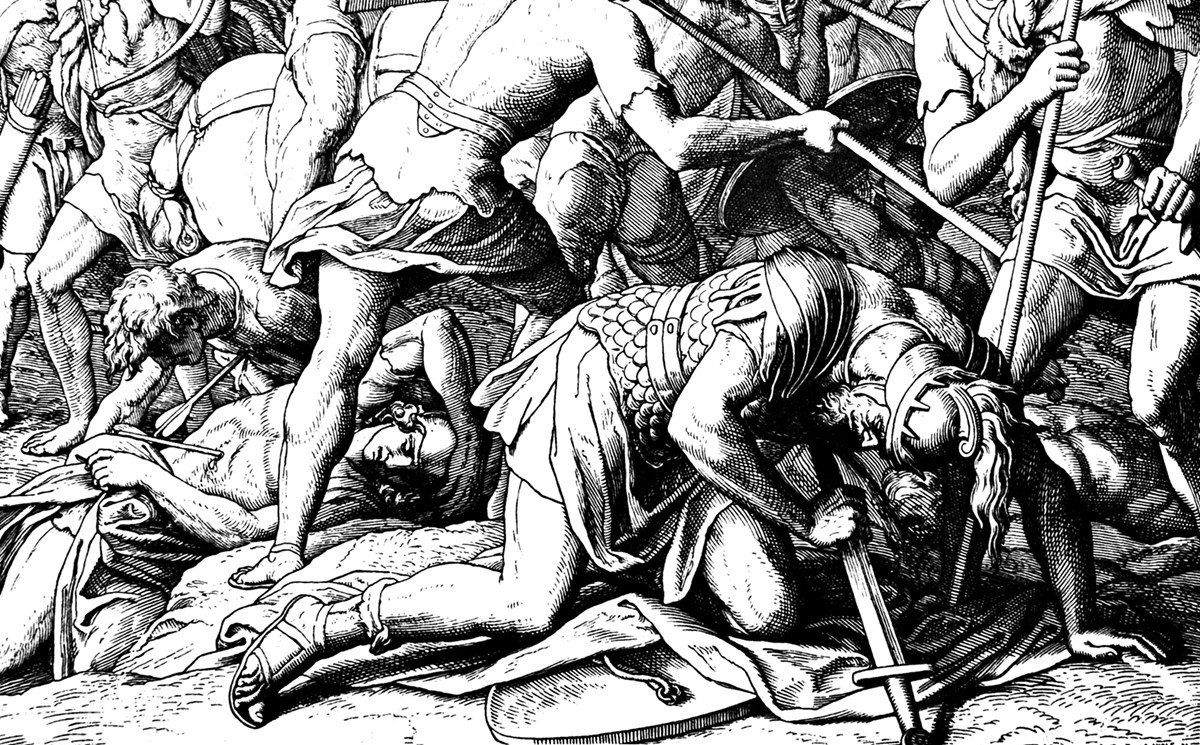
The prophecy “for tomorrow” that comes true three days later


